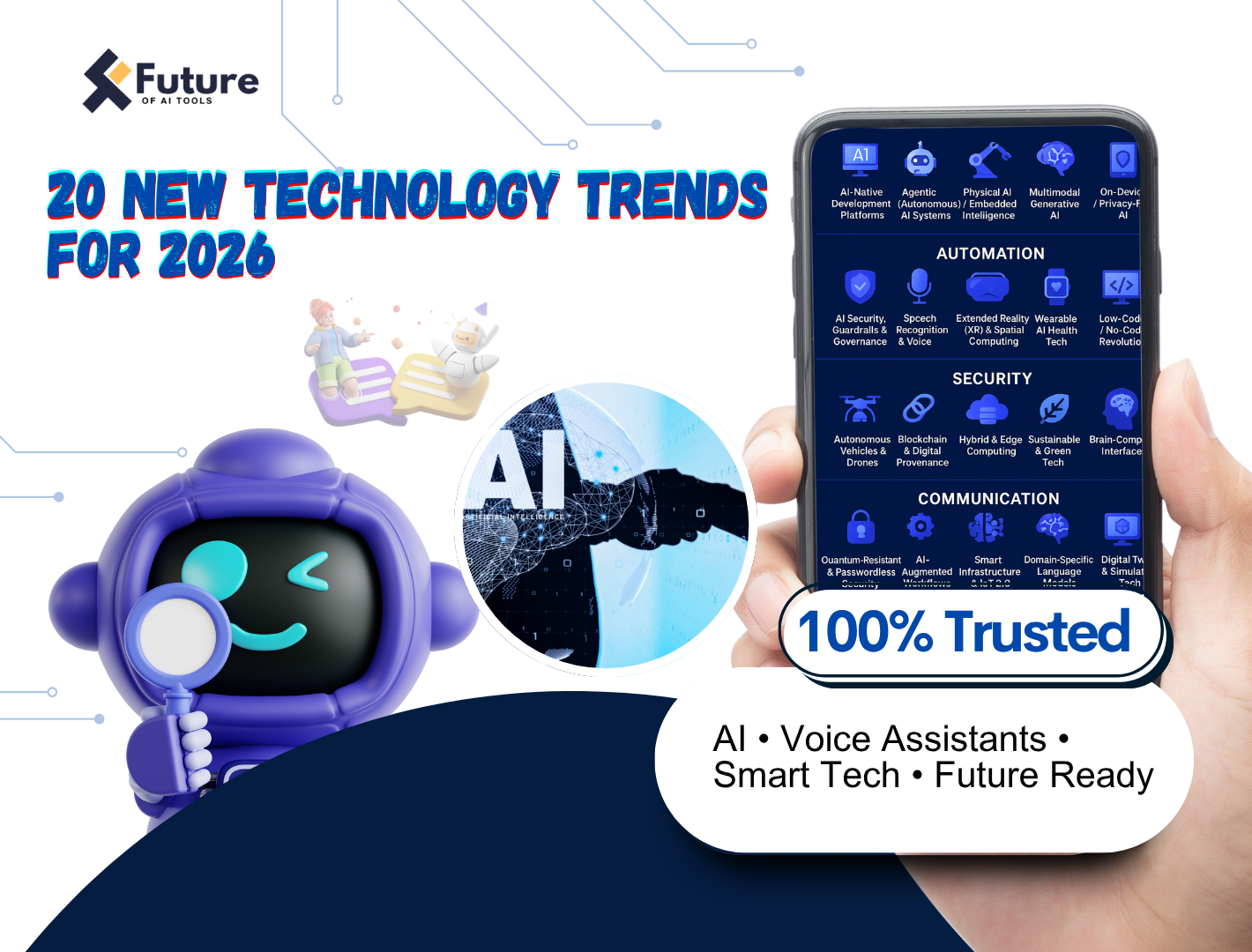
1. AI-Native Development Platforms
Tools built on AI cores that automate software design, coding, and testing-enabling both developers and non-tech users to build applications with ease.
2. Agentic (Autonomous) AI Systems
AI agents that make independent decisions and automatically execute complex workflows like sending emails, analyzing data, and creating content.
3. Physical AI / Embedded Intelligence
AI sensors, robots, and edge devices that “think” and act in the real world – forming the backbone of smart factories and autonomous drones.
4. Multimodal Generative AI
AI models that combine text, audio, video, and image to produce unified outputs -from presentations and visuals to automated reports.
5. On-Device / Privacy-First AI
AI computation performed locally on devices (phones, wearables) – improving both privacy and latency while reducing cloud dependency.
6. AI Security, Guardrails & Governance
Trustworthy AI frameworks with guardrails and audit systems designed to prevent fake data, bias, and prompt injection attacks.
7. Speech Recognition & Voice Interfaces
AI voice assistants and natural language processing (NLP) enabling seamless communication between humans and machines – the core of the future of AI communication.
8. Extended Reality (XR) & Spatial Computing
Integrated AR/VR/MR systems creating immersive experiences in design, education, and healthcare.
9. Wearable AI Health Tech
Smartwatches and biometric sensors powered by AI to analyze real-time health data and provide early health warnings.
10. Low-Code / No-Code Revolution
AI-driven development tools empowering non-programmers to build full-scale applications – accelerating business innovation.
11. Autonomous Vehicles & Drones
Self-driving cars, delivery drones, and warehouse robots revolutionizing logistics and transportation with real-time AI decision-making.
12. Blockchain & Digital Provenance
Beyond cryptocurrency – blockchain for data verification, digital identity, and transparent software supply chains.
13. Hybrid & Edge Computing
A hybrid architecture combining cloud and edge processing for faster, more secure, real-time AI computation.
14. Sustainable & Green Tech
AI-powered energy optimization, carbon capture technology, and smart grids promoting planet-friendly, sustainable computing.
15. Brain-Computer Interfaces (BCIs)
Neurotechnology that converts human thoughts directly into computer inputs – redefining how we communicate and control devices.
16. Quantum-Resistant & Passwordless Security
Security systems built to withstand quantum computing threats -enabling a password-free world through biometrics and passkeys.
17. AI-Augmented Workflows
AI copilots in productivity tools (Microsoft 365 Copilot, Notion AI, Google Gemini) working alongside humans to enhance efficiency and creativity.
18. Smart Infrastructure & IoT 2.0
Connected sensors combined with AI to create intelligent systems for smart cities, traffic management, and industrial automation.
19. Domain-Specific Language Models
Specialized AI models fine-tuned for industries such as healthcare, legal, and finance – more accurate and efficient than general-purpose AIs.
20. Digital Twins & Simulation Tech
AI-powered digital replicas of real-world systems (factories, cities, vehicles) that simulate and optimize operations in real time.
How It Works: The Core of 20 New Technology Trends for 2026
At the heart of the 20 new technology trends for 2026 lies the growing integration of AI, automation, and intelligent computing. AI is no longer confined to data centers – it’s now embedded into our daily tools, from voice-controlled devices to personalized recommendation engines.
Key components include:
- AI-native platforms that automate development and testing.
- Edge computing enabling faster, on-device AI processing.
- Natural language processing (NLP) powering seamless human-computer communication.
- Speech recognition models that understand tone, emotion, and intent.
- Voice interfaces replacing traditional input methods.
These foundations are driving the future of AI communication, making technology more intuitive, conversational, and human-like.
Real-World Applications of the 20 New Technology Trends for 2026
Here’s how these innovations are impacting industries worldwide:
- Healthcare – AI wearables monitor real-time vitals and predict health issues before they occur.
- Education – Virtual classrooms use AI tutors and AI voice assistants for interactive learning.
- Retail – Smart recommendation systems and voice-controlled devices enhance the shopping experience.
- Automotive – Self-driving cars leverage edge AI for real-time decision-making.
- Finance – Secure, blockchain-based AI systems ensure transparent and traceable transactions.
- Smart Homes – From thermostats to kitchen appliances, AI voice assistants manage daily routines effortlessly.
Every innovation within these 20 new technology trends for 2026 contributes to making AI more accessible, efficient, and personalized.
Benefits of the 20 New Technology Trends for 2026
The benefits go far beyond convenience -these technologies redefine productivity, creativity, and human interaction.
- Efficiency: Automated workflows powered by AI voice assistants reduce manual effort.
- Accessibility: Speech recognition and natural language processing help break barriers for people with disabilities.
- Personalization: AI learns from user behavior, providing customized solutions across industries.
- Innovation: Businesses adopting these 20 new technology trends for 2026 will gain a competitive edge through smarter decision-making.
- Sustainability: Green tech and smart infrastructure support eco-friendly innovation.
When technology understands not just our words but our intent, the future of AI communication becomes seamless and empathetic.
Challenges in Adopting the 20 New Technology Trends for 2026
Despite the potential, the road ahead isn’t without challenges.
- Data Privacy: On-device AI needs robust protection to safeguard sensitive information.
- Security Risks: Autonomous systems and AI-driven platforms must defend against cyber threats.
- Integration Issues: Businesses often struggle to merge traditional systems with next-gen AI tools.
- Ethical Concerns: Responsible AI development and governance remain top priorities.
- High Implementation Cost: Cutting-edge voice interface and NLP solutions can be expensive to scale initially.
Organizations like IBM and Google AI are actively working on frameworks to address these challenges and promote safe AI adoption.
Future Scope: Where the 20 New Technology Trends for 2026 Are Headed
The future of AI communication will look radically different in just a few years. AI will move beyond assistants and chatbots to become intelligent collaborators that understand, learn, and anticipate human needs.
Emerging directions include:
- Hyper-personalized AI ecosystems-digital companions that learn across platforms.
- Voice-first interfaces -the new standard for user interaction.
- Brain-computer interfaces -merging biological signals with computing power.
- Quantum computing – solving complex AI problems faster than ever.
- Sustainable AI models – minimizing environmental impact while maintaining accuracy.
By 2026, speech recognition and AI voice assistants will likely become as essential as smartphones are today. This shift will redefine industries and lifestyles, creating a world where humans and machines communicate almost effortlessly.
Integrating 20 New Technology Trends for 2026 in Business
To stay competitive, businesses must embrace these trends proactively. Here’s how to start:
- Adopt AI-native platforms – Automate development and enhance productivity.
- Implement voice-enabled services – Improve accessibility and engagement.
- Invest in data governance – Build trust with transparent, ethical AI practices.
- Collaborate with experts – Partner with AI-focused brands such as futureofaitoos.in to guide your digital transformation.
- Train your workforce -Upskill teams to adapt to AI-driven workflows and voice technologies.
These steps can position any organization as a front-runner in leveraging the 20 new technology trends for 2026 effectively.
Conclusion: Embrace the Future of AI Communication
The 20 new technology trends for 2026 are not just predictions-they’re a roadmap to the next era of innovation. As speech recognition, AI voice assistants, and natural language processing evolve, our interactions with machines will feel more natural, conversational, and productive than ever.
If you’re ready to explore how these advancements can transform your business or career, visit futureofaitoos.in – your trusted partner in navigating the future of AI communication.